
The Difference Between Credit Unions and Banks: A Cloquet, Floodwood, and Moose Lake Minnesota Comparison
The Difference Between Credit Unions and Banks: A Cloquet, Floodwood, and Moose Lake Minnesota Comparison
In the world of financial institutions, there are two primary options that people turn to when they need banking services: credit unions and banks. They both offer a range of financial products and services, but they operate differently and have distinct characteristics.
If you’re a resident of Cloquet, Floodwood, Moose Lake, or located somewhere else in Carlton County and its surrounding areas and you’re wondering which option is right for you, this article will provide a detailed comparison between credit unions and banks.
We’ll explore the advantages and disadvantages of each, helping you make an informed decision about where to entrust your financial needs.
What is a Credit Union?
A credit union is a financial institution that is owned and operated by its members. In other words, the people who have accounts with the credit union are also its owners. Credit unions are typically smaller in scale compared to banks and often serve specific communities or groups of people. They are known for their cooperative structure, where members have a say in the credit union’s operations and decisions.
How Does a Credit Union Operate?
Credit unions are not-for-profit organizations, which means they are focused on providing financial services to their members rather than generating profits for shareholders. This can often result in better interest rates on savings accounts and loans, as well as lower fees. (You can see our rates here)
What is a Bank?
Banks, on the other hand, are for-profit institutions that are owned by shareholders. They can be local, regional, or national in scope and are often much larger in size compared to credit unions. Banks are known for their extensive range of financial products and services, including checking and savings accounts, loans, credit cards, and investment options.
How Does a Bank Operate?
Banks operate with the goal of making a profit for their shareholders. This can lead to higher fees and lower interest rates on savings accounts when compared to credit unions. Banks also tend to have more branches and ATMs, which can be convenient for customers who value accessibility but might hinder personalization with banking.
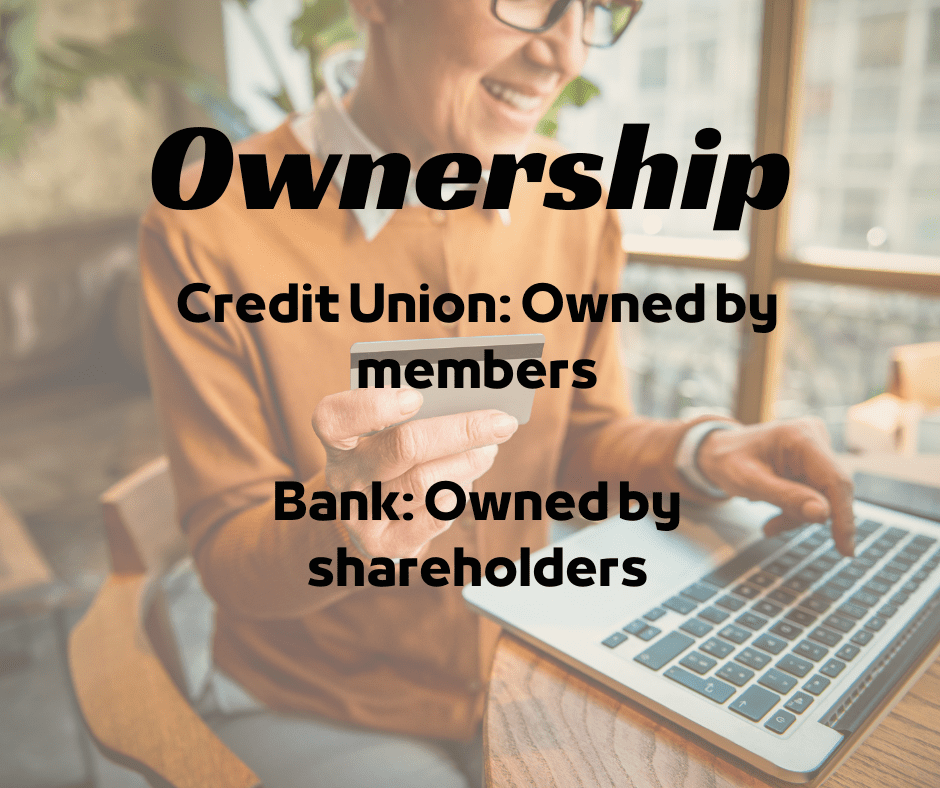
Ownership Structure
Credit Union: Owned and operated by its members. Bank: Owned by shareholders and operated for profit.
Membership vs. Customer
Credit Union: Members are owners and have a say in operations. Bank: Customers have no ownership stake and limited influence.
Profit vs. Non-profit
Credit Union: Not-for-profit, focused on member benefits. Bank: For-profit, focused on generating shareholder returns.
Interest Rates and Fees
Credit Union: Typically offers competitive interest rates and lower fees. Bank: Interest rates and fees can vary widely and may be less favorable.
Branch Locations
Credit Union: Fewer branches, often community-focused. Bank: More branches, including regional and national presence.
Access to ATMs
Credit Union: Limited ATM network, may incur fees. Bank: Extensive ATM network, often with fee-free options.
Customer Service
Credit Union: Personalized service, strong community ties. Bank: Service may vary, more impersonal in larger institutions.
Technology and Online Banking
Credit Union: May have limited online features. Bank: Typically offers advanced online and mobile banking services. (Northwoods Credit Union recently upgraded our online and mobile banking offerings)
Loan Options
Credit Union: May have competitive loan rates, especially for members. Bank: Offers a wide range of loan options, terms may vary.
Savings and Checking Accounts
Credit Union: Competitive rates on savings accounts. Bank: Offers various account types, rates may vary.
Security
Credit Union: Regulated and insured for deposits. Bank: Regulated and insured for deposits.
Insurance
Credit Union: Insured up to $250,000 per account by NCUA. Bank: Insured up to $250,000 per account by FDIC.
Conclusion
In the Cloquet, Floodwood, and Moose Lake areas of Minnesota, both credit unions and banks offer valuable financial services. Your choice between the two will depend on your specific financial needs and preferences. Credit unions excel in providing a sense of community and often offer better rates and fees. Banks, on the other hand, provide convenience through a larger branch and ATM network and a wide range of financial products.
Ultimately, the decision between a credit union and a bank should be based on your individual circumstances, such as your financial goals, location, and the level of personal service you desire. Ready to make the switch to Northwoods Credit Union? We make it easy with our switch kit!
FAQs (Frequently Asked Questions)
1. What are the main differences between a credit union and a bank?
- The primary differences include ownership (credit unions are member-owned, while banks are owned by shareholders), profit structure (credit unions are not-for-profit, banks are for-profit), and the range of financial products and services offered.
2. Are credit unions more community-focused than banks?
- Yes, credit unions often have a strong community presence and may tailor their services to meet the needs of specific communities or groups of people.
3. Do credit unions and banks offer similar interest rates and fees?
- Interest rates and fees can vary, but credit unions are known for offering competitive rates on savings accounts and loans, as well as lower fees.
4. Is my money safe in a credit union or bank?
- Both credit unions and banks are regulated and insured for deposits, providing a level of security for your funds.
5. Can I access my credit union or bank accounts online?
- Yes, most credit unions and banks offer online and mobile banking services, but the level of technology and features may differ. Here at NCU, we offer a wide range of online banking services!
The following written content was generated by NCU staff with assistance from an AI-based system.
Test Modal
Modal Content
Ea rerum vel molestiae omnis molestias. Et ut officiis aliquam earum et cum deleniti. Rerum temporibus ex cumque doloribus voluptatem alias.
Open Account
Leaving Our Website
You are leaving our website and linking to an alternative website not operated by us. We do not endorse or guarantee the products, information, or recommendations provided by third-party vendors or third-party linked sites.